Choosing the right machine learning server manufacturer requires more than comparing processor counts. Worldwide buyers must examine accelerator compatibility, memory bandwidth, networking, cooling design, and long-term service support. A server may look powerful on paper, yet perform poorly when models require constant data movement.
This guide introduces leading manufacturers across North America, Europe, and Asia. It considers companies such as Dell Technologies, HPE, Lenovo, Supermicro, NVIDIA, and specialized infrastructure providers. Their systems serve different environments, including university laboratories, cloud platforms, automotive research centers, and enterprise data rooms. Practical details matter. Rack depth, power delivery, firmware updates, and replacement times can affect daily operations.
NVIDIA CEO Jensen Huang once quipped, “The more you buy, the more you save.” The remark reflects the economics of accelerated computing, although it should not become a purchasing rule. Bigger clusters can increase speed, but they also increase electricity use, cooling demands, and management complexity. Sometimes, a smaller server with faster storage delivers better value.
This overview uses technical specifications, deployment experience, warranty policies, and independent performance evidence. It avoids treating benchmark scores as absolute truth. Results can change with software versions, model sizes, and workload design. That uncertainty deserves attention. A reliable comparison should ask not only who builds the fastest machine, but who supports it when the room becomes hot, the GPUs remain idle, or a critical component fails.
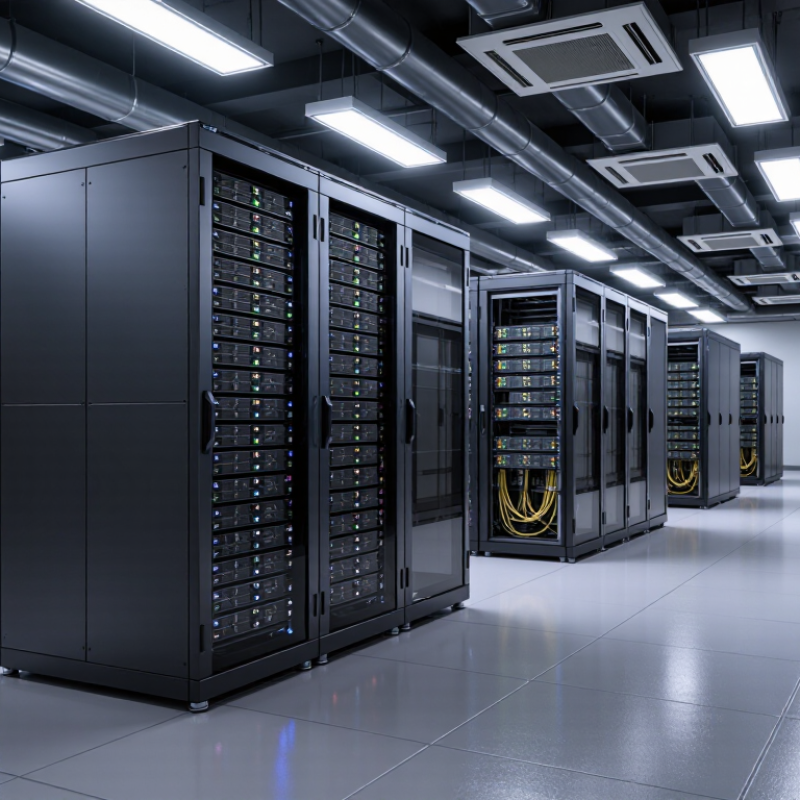
Machine Learning Servers: Definition, Components, and Core Applications
Machine learning servers are specialized systems built to train models, process large datasets, and deliver rapid predictions. Unlike ordinary office servers, they combine powerful processors, accelerator cards, fast memory, and high-speed storage. A typical configuration may include multi-core CPUs, GPUs or other accelerators, 256 GB or more of RAM, and NVMe drives for frequent data access. Reliable networking is also essential when several servers share training workloads.
Core components affect practical performance. Accelerators handle matrix calculations, while CPUs manage data preparation, scheduling, and system tasks. Cooling systems remove heat from densely packed hardware, especially during long training sessions. Redundant power supplies and error-correcting memory help reduce interruptions. These servers support computer vision, language processing, fraud detection, recommendation engines, and scientific simulation. Manufacturers worldwide commonly offer rack-mounted, modular, and liquid-cooled designs, but specifications vary widely. More hardware does not always mean better results.
Tips: Match the server to the model and dataset, not marketing claims. Check accelerator memory before comparing processing speed. Test data-loading performance with real workloads. Monitor temperature, power use, and failure logs during a pilot deployment. Keep spare storage capacity for larger datasets. A useful review should include measured training time, not only advertised peak performance. I have seen systems with impressive specifications slow down because storage and cooling were poorly balanced. That detail is easy to miss.
Leading Machine Learning Server Manufacturers by Global Market Presence
Top Machine Learning Server Manufacturers Worldwide?
Leading machine learning server manufacturers are measured by global market presence, not publicity alone. Strong suppliers serve data centers across North America, Europe, and Asia-Pacific. They maintain regional logistics, technical support, and certified service partners. Their systems often combine accelerated processors, high-speed memory, and flexible networking. Rack density matters when facilities face limited floor space. Power efficiency matters even more as training workloads expand.
Market leaders usually publish benchmark results, warranty terms, and configuration guides. They support different deployment sizes, from compact research clusters to enterprise-scale installations. Reliable manufacturers also design for thermal stability, cable management, and predictable maintenance. Still, public rankings can mislead. Sales data may be incomplete, and regional demand changes quickly. A supplier with strong hardware may lack local engineers. That weakness becomes visible during a failed overnight job.
Tips: Compare support coverage before comparing processor counts. Ask for measured performance under your workload. Check replacement timelines, firmware policies, and cooling requirements. Request references from organizations with similar cluster sizes. A cheaper server can become expensive when energy and downtime accumulate. Leave room for upgrades. Many buyers underestimate future memory needs.
Manufacturers with the widest presence are not always the best fit for every team. Evaluation should include compliance documentation, integration experience, and long-term operating costs. Independent testing adds confidence, but test conditions require careful review. A practical decision may favor dependable regional service over impressive peak performance. That choice is less glamorous, yet often more reliable.
Key Technologies Used in Modern Machine Learning Server Systems
Top Machine Learning Server Manufacturers Worldwide?
Modern machine learning servers are defined less by appearance than by how efficiently they move data. Accelerators handle matrix calculations, while high-bandwidth memory feeds them with fewer delays. In practical deployments, this balance often matters more than peak processing claims. A server can look powerful yet waste energy when memory access becomes the bottleneck.
High-speed interconnects link multiple accelerators inside one chassis. They reduce communication delays during model training. Fast NVMe storage supports large datasets and frequent checkpoint writes. Many systems also use direct data paths, reducing unnecessary processor copying.
Liquid cooling is becoming useful for dense configurations, especially in compact data rooms. It can control heat more quietly, but maintenance planning becomes harder. That trade-off deserves attention.
Reliable systems need more than hardware. Orchestration software schedules workloads, isolates users, and tracks accelerator utilization. Security features protect model files, credentials, and training data. Remote management helps technicians inspect temperature, power draw, and failed components without opening the rack.
In my experience, monitoring quality often decides whether a server remains dependable after months of heavy use. Specifications can mislead. Real workloads vary. Some newer designs still need better repair access and clearer energy measurements. Procurement teams should test representative models, measure full-system performance, and examine support procedures before deployment.
How to Compare Machine Learning Server Manufacturers and Product Lines
Top Machine Learning Server Manufacturers Worldwide?
Comparing machine learning server manufacturers requires more than counting accelerators. Start with workload evidence: training language models, processing images, or serving predictions each needs different hardware. A server with four accelerators may outperform an eight-accelerator system if memory bandwidth and interconnects are better designed.
Check accelerator memory, host memory, storage speed, and network capacity. Ask for measured results using your datasets, not only laboratory benchmarks. A practical test might process 10,000 images while recording training time, power draw, and error rates. Small details matter. Cooling design matters.
Review the complete product line, including entry systems, dense training nodes, and expansion platforms. A strong manufacturer should offer compatible components across generations. This reduces migration effort when workloads grow. However, product roadmaps can change, and published availability dates are not always dependable. That deserves written confirmation.
Support quality often separates similar machines. Examine response times, replacement procedures, firmware updates, and remote diagnostics. Security controls should include access management, secure boot, and clear vulnerability reporting. Calculate total ownership costs, including electricity, cooling, software licenses, maintenance, and downtime. The cheapest purchase can become expensive later.
I have found spreadsheets useful, but incomplete. They rarely show installation delays or noisy cooling equipment. Visit a reference site when possible. Speak with engineers who operate the systems daily. Their complaints may reveal more than a polished demonstration. Keep the evaluation repeatable, and document every assumption before comparing quotes.
Industry Trends Shaping the Future of Machine Learning Servers
Top Machine Learning Server Manufacturers Worldwide?
Machine learning servers are changing as workloads become larger, faster, and less predictable. Modern systems increasingly combine CPUs, GPUs, specialized accelerators, and high-speed networking. This heterogeneous design improves flexibility, but it also makes hardware planning harder. A server may perform well in training tests yet struggle during real-time inference.
Memory bandwidth is becoming as important as processor speed. Large models repeatedly move data between memory, storage, and accelerators. Faster memory and local storage can reduce waiting time, especially in recommendation and language applications. Engineers are also adopting liquid cooling for dense racks. In practical deployments, temperature sensors, airflow planning, and power limits can determine reliability more than advertised peak performance.
Energy efficiency is gaining operational importance. Data centers now measure performance per watt, not only raw computing speed. Modular servers allow teams to replace accelerators without rebuilding entire systems. Edge computing is growing too, because factories, hospitals, and vehicles often need immediate responses. However, smaller edge systems have limited cooling and memory. That trade-off is easy to underestimate.
Security is moving closer to the hardware layer. Protected memory, verified boot processes, and isolated workloads help reduce exposure during model training. Supply-chain verification also matters. A difficult lesson remains: benchmark scores rarely predict every production result. Workloads change, software updates introduce variation, and cooling costs can erase expected savings. Careful testing under realistic data, latency, and power conditions remains essential.
Industry Trends Shaping the Future of Machine Learning Servers
AI servers are becoming a larger portion of the global server market as demand for accelerated computing, large-scale model training, and generative AI inference continues to expand.
Data source: TrendForce industry estimates and forecasts for the share of AI servers in global server shipments. Values represent the percentage of total server shipments.
FAQS
It is a specialized system for training models, processing datasets, and producing rapid predictions. It combines processors, accelerators, memory, storage, cooling, and networking.
CPUs prepare data and manage system tasks. Accelerators perform matrix calculations. Fast memory and storage keep workloads moving. Cooling and reliable power prevent interruptions.
Accelerators process many calculations in parallel. They can shorten training time for vision, language, and scientific models. Their memory capacity also matters greatly.
A typical configuration may include 256 GB or more of RAM. Larger datasets may require additional capacity. More memory does not automatically improve every workload.
NVMe drives support frequent dataset access and checkpoint writes. They reduce waiting during training. Keep spare capacity for future datasets.
No. Peak figures can mislead. Test real data loading, measured training time, power use, and temperature. A slower-looking system may perform better overall.
Dense hardware produces substantial heat during long training sessions. Liquid cooling can manage heat quietly. However, maintenance becomes more complicated. That trade-off deserves testing.
Orchestration software schedules workloads and tracks accelerator use. Remote management checks temperatures, power draw, and failed components. Security controls protect credentials, model files, and training data.
Use representative datasets and models. Record training time, storage speed, power consumption, temperatures, and failure logs. Support procedures also need review. I might overlook repair access.
Conclusion
Machine learning servers are specialized computing systems designed to process large datasets, train complex models, and support demanding artificial intelligence workloads. They typically combine high-performance processors, accelerators, large memory capacity, fast storage, advanced networking, and efficient cooling. Their core applications include model training, real-time inference, scientific research, industrial automation, data analysis, and intelligent business services. This overview explains how leading manufacturers are evaluated by global market presence, product reliability, scalability, energy efficiency, software compatibility, and technical support.
Modern systems increasingly adopt accelerated computing, high-speed interconnects, virtualization, containerized deployment, and flexible cloud-to-data-center integration. When comparing a machine learning server manufacturer, organizations should consider performance per cost, upgrade options, security, workload compatibility, maintenance, and long-term availability. Future development will be shaped by growing AI adoption, demand for lower power consumption, specialized hardware, edge computing, sustainable data centers, and increasingly efficient models. Together, these trends are making machine learning infrastructure more powerful, adaptable, and accessible across industries.
 Aivora
