Aivora
Artificial intelligence is reshaping the data center from the inside out. Racks now carry dense accelerator systems, liquid cooling loops, high-speed fabrics, and demanding power requirements. This guide examines the Top Data Center AI Server Manufacturers Worldwide and the technologies behind their market positions.
A data center ai server manufacturer must deliver more than powerful chips. It needs dependable system design, thermal engineering, firmware support, supply-chain resilience, and responsive service. Buyers should examine GPU compatibility, memory capacity, networking speed, energy efficiency, deployment timelines, and long-term maintenance. A server that performs well in a laboratory may struggle inside a crowded production rack.
Jensen Huang, NVIDIA’s founder and CEO, said, “The next industrial revolution has begun.” His statement reflects the scale of today’s AI infrastructure shift. Companies such as Dell Technologies, HPE, Lenovo, Supermicro, and NVIDIA influence this transition through different strengths. Some focus on complete enterprise platforms. Others specialize in accelerated computing, customization, or rapid deployment.
Real-world details matter. Operators may compare liquid-cooled cabinets, 400-gigabit networking, rack-level power limits, and GPU availability. These factors often decide a project’s success. Marketing claims alone are insufficient.
No ranking is flawless. Vendor performance changes with component supply, software maturity, regional support, and customer workload. This overview therefore combines technical capability, enterprise experience, innovation, reliability, and market presence. It also recognizes uncertainty, because AI server technology evolves faster than many procurement cycles. The strongest manufacturer today may not remain the strongest tomorrow.
TrendForce forecast approximately 1.6 million AI server units for 2024, showing how quickly data center demand is expanding. This estimate includes systems built for model training, inference, and high-performance computing. The market is no longer limited to research laboratories. Cloud operators, financial institutions, manufacturers, and public-sector organizations are adding accelerated computing capacity. IDC’s Worldwide AI and Generative AI Spending Guide projects global AI spending will reach about $632 billion by 2028. That growth will pressure manufacturers to improve delivery speed, thermal design, and component reliability.
Tips: Compare total operating cost, not only purchase price. Check power draw, rack density, cooling requirements, and service coverage. A high-performance server can become inefficient when electricity or facility capacity is limited.
Manufacturers worldwide are responding with denser platforms, liquid-cooling options, and modular configurations. Yet the 1.6 million-unit forecast should not be read as guaranteed utilization. Some deployments may face delayed networking, limited power availability, or shortages of skilled technicians.
This is the uncomfortable part. Hardware growth can outpace practical data center readiness. Buyers should validate workload demand, benchmark inference performance, and examine failure-recovery procedures before expanding. TrendForce data signals strong momentum, while IDC’s spending outlook suggests a longer investment cycle. Forecasts remain useful, but real adoption will depend on measurable business results.
Data center AI server procurement is moving toward a small group of global OEM leaders. These manufacturers design rack systems, integrate accelerators, and support deployments across regions. Their advantage is not hardware alone. It includes validated firmware, supply planning, and service teams that understand demanding production environments. In a typical eight-rack cluster, engineers must balance GPU density, airflow, power feeds, and network latency. A capable supplier can document those trade-offs before equipment reaches the site. That matters.
The leading vendors differ in chassis design, accelerator compatibility, and liquid-cooling options. Some offer dense four-GPU nodes for model training. Others favor flexible two-socket systems for mixed analytics and inference.
Buyers should examine thermal test reports, replacement targets, and support coverage in each country. Hands-on proof is essential: run a representative workload, measure rack-level power, and inspect recovery after a node failure. Marketing specifications rarely reveal those details. Neither does a short demo.
Independent validation still has limits. A benchmark may use ideal data, skilled operators, or unusually clean power. Real facilities face dust, delayed parts, uneven workloads, and rushed upgrades. No shortlist is perfect. Procurement teams should record assumptions and revisit them after deployment. The strongest OEM relationship is practical: clear escalation paths, transparent spare inventories, and engineers who admit when a design needs revision. That honesty may protect uptime better than a polished performance claim.
Data center AI server manufacturing is shifting from standard computing toward accelerated platforms. One reported figure illustrates the scale: a leading GPU platform vendor generated $115.2 billion in FY2025 data center revenue. That number reflects more than chip demand. It includes strong adoption of complete systems, networking, and software tools. The momentum is real. However, revenue alone does not prove every deployment is efficient or profitable.
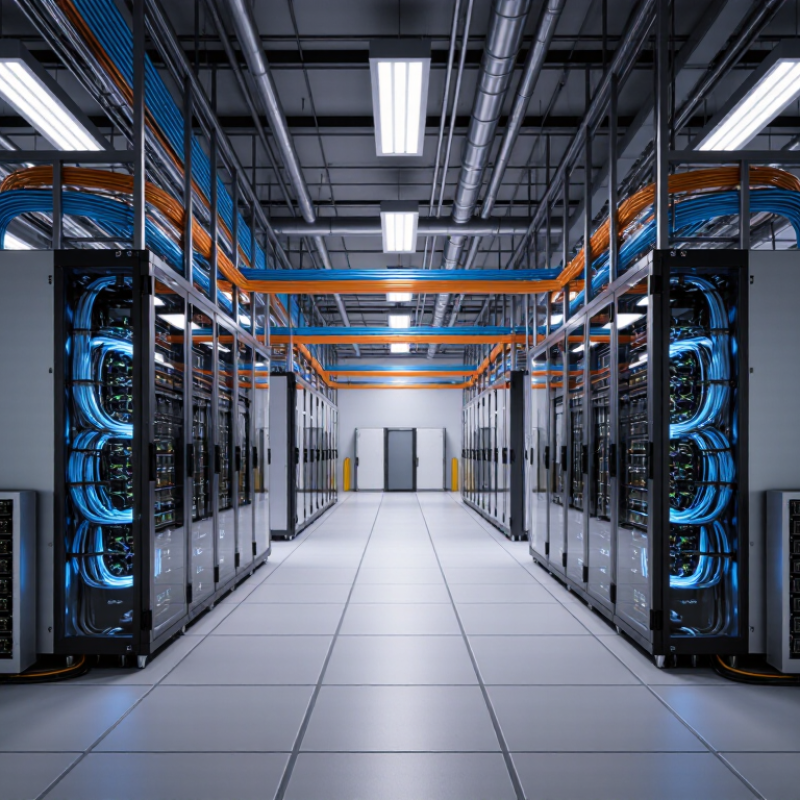
For manufacturers worldwide, performance depends on the entire rack. Engineers must balance GPUs, memory, power delivery, cooling, and high-speed connections. A dense rack can exceed several dozen kilowatts, creating serious thermal pressure. Liquid cooling is becoming practical in these environments. Installation teams also need reliable service procedures and replacement parts. Small delays can leave expensive compute capacity unused.
Buyers should examine measured throughput, energy use, and workload consistency. Marketing benchmarks may not match production results. That gap matters. Audited financial reports should support the $115.2 billion figure, while independent testing should validate system performance. The market still has weaknesses, including supply concentration, long delivery schedules, and uncertain utilization. A technically impressive server can become wasteful when workloads are poorly planned. Procurement teams should question assumptions before expanding capacity.
Asia-Pacific has become a critical base for data center AI server manufacturing. Regional producers combine strong electronics supply chains, engineering talent, and close access to cloud operators. One major Chinese manufacturer emphasizes integrated computing platforms, networking, and domestic support. Its strength is rapid customization for large public and enterprise deployments. However, export controls and component availability can complicate international projects.
A leading Japanese manufacturer focuses on reliability, energy efficiency, and carefully managed service operations. Its systems often suit research institutions and corporate data centers that value predictable maintenance. Meanwhile, a large Taiwanese original design manufacturer builds high-density servers for global technology companies. Its advantage comes from flexible production and close coordination with chip suppliers. Rack-scale testing, liquid cooling checks, and firmware validation happen before shipment.
Another Taiwanese manufacturer competes through design speed and scalable production. It can adapt chassis layouts for different accelerators, storage needs, and power limits. Field experience shows that performance figures alone are not enough. A server may deliver excellent benchmark results but struggle in a crowded rack. Noise, heat removal, replacement time, and remote monitoring matter every day. No regional producer wins every test. Procurement teams should verify delivery records, local support coverage, security controls, and long-term parts availability. Some evaluations still overlook technician training, which can create avoidable downtime. That weakness deserves more attention.
AI server manufacturers are now judged by rack density, cooling efficiency, and network bandwidth. Uptime Institute’s 2024 Global Data Center Survey reports that higher-power racks are becoming common, while operators face tighter power limits. Traditional air cooling often struggles beyond 20–30 kW per rack. AI-focused systems may exceed 40 kW, with some designs approaching 100 kW.
Liquid cooling is becoming practical, not experimental. Direct-to-chip systems can remove heat from processors more efficiently than room-level airflow. The Open Compute Project highlights warm-water cooling near 60°C as a useful design direction. However, coolant distribution, leak detection, and maintenance skills remain difficult. This is where many evaluations become too optimistic.
Network performance is equally important. The Ethernet Alliance’s 2024 roadmap identifies 400GbE as a current foundation for accelerated computing, while 800GbE supports larger east-west traffic flows. Higher link speeds reduce congestion between servers, switches, and storage, but they also increase optical, power, and cabling complexity. Dell’Oro Group expects AI-related networking demand to remain a major data-center growth driver through the decade. That forecast is persuasive, yet procurement teams should test real workloads rather than trust headline throughput. A dense rack with weak cooling is still a bottleneck.
| Competitive Configuration | Typical Accelerator Capacity per 42U Rack | Typical IT Load per Rack | Rack Density Classification | Cooling Architecture | Liquid-Cooling Coverage | 400GbE Networking | 800GbE Networking | Typical Use Case | Deployment Maturity |
|---|---|---|---|---|---|---|---|---|---|
| General-Purpose AI Training Rack | 8–16 accelerator modules | 30–60 kW | High density | Rear-door heat exchanger or hybrid air/liquid cooling | 25–60% of rack heat load, depending on accelerator TDP and chassis design | Common for scale-out fabric uplinks and leaf-spine connections | Available for high-radix spine or inter-cluster links | Large-model training, distributed fine-tuning, scientific computing | Mature |
| High-Density GPU Training Rack | 16–32 accelerator modules | 60–100 kW | Very high density | Direct-to-chip cold plates with facility-water distribution units | 60–90% of rack heat load; residual heat is normally removed by air | Standard for node-to-leaf and leaf-to-spine connectivity | Increasingly used for spine, rail-optimized, and east-west traffic | Dense model training and high-throughput data parallelism | Scaling |
| Liquid-Cooled Supernode Rack | 32–64 accelerator modules | 80–120+ kW | Extreme density | Direct liquid cooling with warm-water or facility-water loops | 80–95% of rack heat load | Used for management, storage, and selected cluster fabrics | Preferred for high-bandwidth scale-up and scale-out fabrics | Frontier-scale training and tightly coupled AI workloads | Scaling |
| Air-Cooled Inference Rack | 4–16 accelerator modules | 10–35 kW | Medium to high density | Hot-aisle containment with high-efficiency variable-speed fans | 0–20%; air cooling remains the primary heat-removal method | Common where multiple inference nodes share a high-speed fabric | Selective use; generally justified only at large cluster scale | Real-time inference, recommendation engines, and batch serving | Mature |
| Hybrid CPU–Accelerator Cloud Rack | 4–16 accelerator modules plus general-purpose compute nodes | 15–45 kW | Medium to high density | Advanced air cooling or partial direct-to-chip liquid cooling | 10–50%, depending on the proportion of accelerator nodes | Widely used for tenant-facing service networks and cluster aggregation | Optional for premium AI instances and regional backbone links | Multi-tenant AI cloud, virtualized training, and inference services | Mature |
| Specialized HPC–AI Rack | 8–32 accelerator modules | 40–90 kW | High to very high density | Direct-to-chip liquid cooling or rear-door heat exchanger | 50–90% of rack heat load | Common for parallel file systems, storage fabrics, and cluster interconnects | Used when aggregate bandwidth and port density justify the added cost | Simulation, digital twins, genomics, and engineering workloads | Mature |
| Edge and Regional AI Rack | 1–8 accelerator modules | 5–20 kW | Standard to medium density | Conventional air cooling with environmental monitoring | Normally 0%; liquid cooling is uncommon in space-constrained edge sites | Used for regional aggregation and backhaul where required | Rare because power, optics, and switch-port requirements are difficult to justify | Low-latency inference, video analytics, and industrial AI | Emerging |
About 1.6 million AI server units are forecast for 2024. These systems support training, inference, and high-performance computing. The forecast shows strong demand. It is not guaranteed utilization.
Cloud operators, financial institutions, manufacturers, and public-sector organizations are expanding capacity. The market has moved beyond research laboratories. Some buyers may expand too quickly. Actual workload demand still needs proof.
Compare total operating cost, not only the purchase price. Review power consumption, rack density, cooling, maintenance, and service coverage. A powerful server may become inefficient in a facility with limited electricity. The invoice is only part of the cost.
Dense racks can generate several dozen kilowatts of heat. Air cooling may become insufficient in crowded facilities. Liquid cooling can improve heat removal and system stability. Installation is not simple. Teams need trained technicians and reliable replacement procedures.
No. Revenue indicates market momentum, but it does not prove efficient utilization. Buyers should measure throughput, energy use, and workload consistency. Production results may differ from marketing benchmarks. That gap matters.
Validate workload demand and benchmark real inference performance. Check networking readiness, available power, and failure-recovery procedures. Review delivery records and local technical support. Expansion can outpace data center readiness.
Some provide rapid customization and close domestic support. Others emphasize reliability, energy efficiency, or flexible production. Manufacturers may adapt chassis layouts for different accelerators and power limits. No supplier wins every test.
Buyers should inspect noise, heat removal, remote monitoring, and replacement time. They should also confirm firmware testing and liquid-cooling checks. Technician training is often overlooked. That can cause avoidable downtime. It deserves more attention.
The global data center AI server market is entering a rapid expansion phase, with industry forecasts estimating approximately 1.6 million units in 2024. Leading original equipment manufacturers and regional suppliers are competing to deliver scalable systems that support advanced AI training, inference, and cloud workloads. A successful data center AI server manufacturer must balance processing performance, energy efficiency, supply-chain reliability, and flexible configurations for different enterprise and hyperscale requirements.
GPU-based platforms remain central to this market, supported by strong data center revenue growth and continued demand for accelerated computing. Meanwhile, manufacturers are differentiating themselves through higher rack density, direct liquid cooling, and 400/800GbE networking. These technologies help improve thermal management, reduce power constraints, and accelerate data movement between servers. As AI workloads become more complex, manufacturers that combine efficient hardware design, robust networking, and regional service capabilities will be better positioned to compete worldwide.
