 Aivora
Aivora
Aivora
Artificial intelligence has moved from experimental labs into production factories, hospitals, financial institutions, and public services. Gartner forecasts worldwide AI spending will reach about $1.5 trillion in 2025. That growth is increasing demand for dense, reliable computing infrastructure. Yet not every AI computing server manufacturer offers the same engineering depth, service coverage, or upgrade path.
TrendForce reported that global AI server shipments are expected to maintain strong growth through 2025. Its analysis highlights rising demand for GPU servers, liquid cooling, and high-speed networking. The Stanford AI Index 2025 also recorded $252.3 billion in global private AI investment during 2024. These figures explain the market’s momentum, but they do not identify the best supplier for every buyer. Definitions differ. Forecasts can age quickly.
This guide examines leading AI server manufacturers from a buyer’s perspective. It considers GPU compatibility, thermal design, power efficiency, rack density, manufacturing quality, and global support. It also examines certifications, warranty terms, lead times, and integration experience. A server may look powerful on paper. Its real value appears during deployment, maintenance, and workload expansion. Small details matter, such as fan noise, cable routing, firmware updates, and replacement-part availability. Very few vendors excel everywhere. Buyers should question impressive specifications and request workload-specific benchmarks. That step is sometimes skipped, and it can become an expensive mistake. The manufacturers discussed here are assessed using public industry reports, technical documentation, and practical procurement criteria. Performance claims still require independent verification.
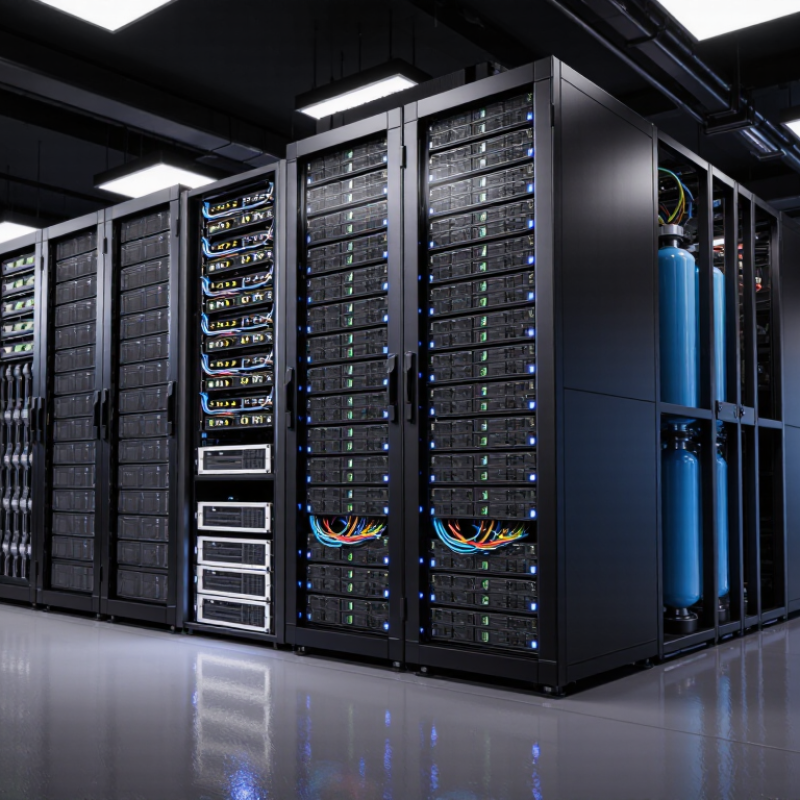
AI computing servers are systems designed to process workloads that involve training or running artificial intelligence models. Unlike general-purpose servers, they often combine multiple processors, high-bandwidth memory, and fast links between processors. A typical rack may contain accelerator cards, network switches, power supplies, and cooling equipment. These parts work together to move large datasets and perform many calculations in parallel. In practice, the right configuration depends on model size, workload, and available power—not just peak processing speed.
They are not simply “faster servers.” Training a model can keep accelerators busy for long periods, while inference servers must respond reliably to repeated user requests. The International Energy Agency estimated that data centres used about 415 terawatt-hours of electricity in 2024 and projects consumption could reach around 945 terawatt-hours by 2030, with AI among the key drivers. That makes power efficiency and cooling essential parts of server selection. A dense system can save floor space, yet create hot spots that complicate maintenance. Small details matter. Buyers should check memory capacity, network bandwidth, software compatibility, and measured performance under their actual workloads. Peak figures alone can mislead; real deployments are messier.
| Server Category | Typical Form Factor | AI Workloads | Compute and Memory Profile | Cooling and Power Considerations | Common Deployment Setting |
|---|---|---|---|---|---|
| GPU training server | 4U–8U rack server | Large-model training, computer vision, scientific machine learning | Multiple accelerator cards; high-bandwidth accelerator memory; multi-socket or high-core-count host CPUs; large system memory | High power draw; requires carefully planned rack power, airflow, and thermal capacity. Some configurations use liquid cooling. | AI research clusters and enterprise data centers |
| GPU inference server | 1U–4U rack server | Model serving, image analysis, generative AI inference | One or more accelerators, selected according to model size and throughput needs; CPU and memory sized for data handling and concurrent requests | Power and cooling needs vary with accelerator count and utilization; workload monitoring helps manage operating costs. | Cloud platforms, private data centers, and production AI services |
| High-density accelerator server | 4U–10U rack server or integrated rack-scale system | Distributed training and large-scale model development | High accelerator count with fast interconnects; typically paired with high-throughput networking and substantial memory capacity | Very high rack power density; may require liquid cooling, specialized facility infrastructure, and careful service planning. | Large-scale AI supercomputing and hyperscale environments |
| CPU-based AI server | 1U–2U rack server | Data preprocessing, classical machine learning, lightweight inference | Multi-core CPUs, large system memory, and fast storage; may operate without discrete AI accelerators | Generally simpler to power and cool than accelerator-dense systems, though requirements depend on processor count and configuration. | General-purpose data centers and mixed enterprise workloads |
| Edge AI server | Compact rack, short-depth, or ruggedized enclosure | Low-latency inference, video analytics, industrial inspection | Compact CPU and optional accelerator; storage and memory sized for local data processing | Must match the site’s space, temperature, dust, vibration, and power conditions; remote management can be important. | Factories, retail sites, telecom facilities, and remote locations |
| AI storage and data-preparation server | 2U–4U rack server | Dataset storage, preprocessing, feature pipelines, checkpoint management | High-capacity memory and storage; fast network interfaces; storage may combine solid-state drives and high-capacity hard drives | Power and cooling depend on drive count, network speed, and workload; storage redundancy and backup planning are important. | AI clusters, research institutions, and enterprise data platforms |
What is an AI computing server? It is a server designed or configured to run artificial intelligence workloads. Depending on the task, it may use CPUs, GPUs, or other accelerators, together with suitable memory, storage, networking, and cooling. Specifications and power requirements vary by workload and configuration; the ranges above describe common server categories rather than a specific product.
CPUs, accelerators, high-bandwidth memory, and fast connections work together. Slow storage can still hold everything back.
Define model size, batch size, response-time targets, and daily training hours. A system suited to image analysis may struggle with large language models.
Continuous training can heat a rack quickly. Liquid cooling removes heat effectively, but it adds maintenance and operational complexity. Details matter.
No. Test your own software and data, then measure tokens per second, power use, and thermal throttling. Short tests can miss overnight problems.
Consider electricity, cooling, service response, and replacement-part access. A low price may conceal expensive downtime.
Ask about warranty terms, repair options, spare parts, and recovery targets. Check service availability across your region and time zone.
Verify power limits, rack measurements, network capacity, and cooling assumptions. A small measurement error can delay deployment. Easy to miss.
Confirm destination-specific safety, environmental, import, and export requirements. Request accurate technical documents and check data-location needs with local advisers.
No. Needs vary by workload, site, and support capacity. I may give cooling too much weight, but it deserves an honest review.
AI computing servers are specialized systems designed to handle demanding artificial intelligence workloads such as model training, inference, data analysis, and high-performance computing. They combine powerful processors, accelerator technologies, high-speed memory, efficient networking, advanced cooling, and scalable storage to deliver fast and reliable performance. Their design should support workload flexibility, energy efficiency, system stability, and convenient management for organizations of different sizes.
When evaluating an ai computing server manufacturer, global buyers should compare processing capabilities, expandability, software compatibility, product reliability, security features, and total ownership costs. It is also important to assess manufacturing quality, delivery capacity, warranty terms, technical support, maintenance services, and long-term spare-part availability. In addition, buyers should consider regional compliance requirements, data protection expectations, import regulations, energy standards, and the availability of local service resources. A careful comparison of these factors can help organizations select suitable server models that meet current needs while supporting future growth.
